Businesses today are drowning in information, from documents and emails to policies, reports, and customer chats. Despite this wealth of data, knowledge in enterprises remains fractured and inaccessible. According to 2025 research by Atlassian, employees spend 25% of their time searching for answers instead of taking action.
Early AI solutions sought to tackle this problem, but without access to trusted internal data, generative AI can sound confident but give incorrect information. These hallucinations create a massive drag on organizational performance and can introduce critical productivity, decision-making, and compliance risks.
The solution: Retrieval-augmented generation (RAG)
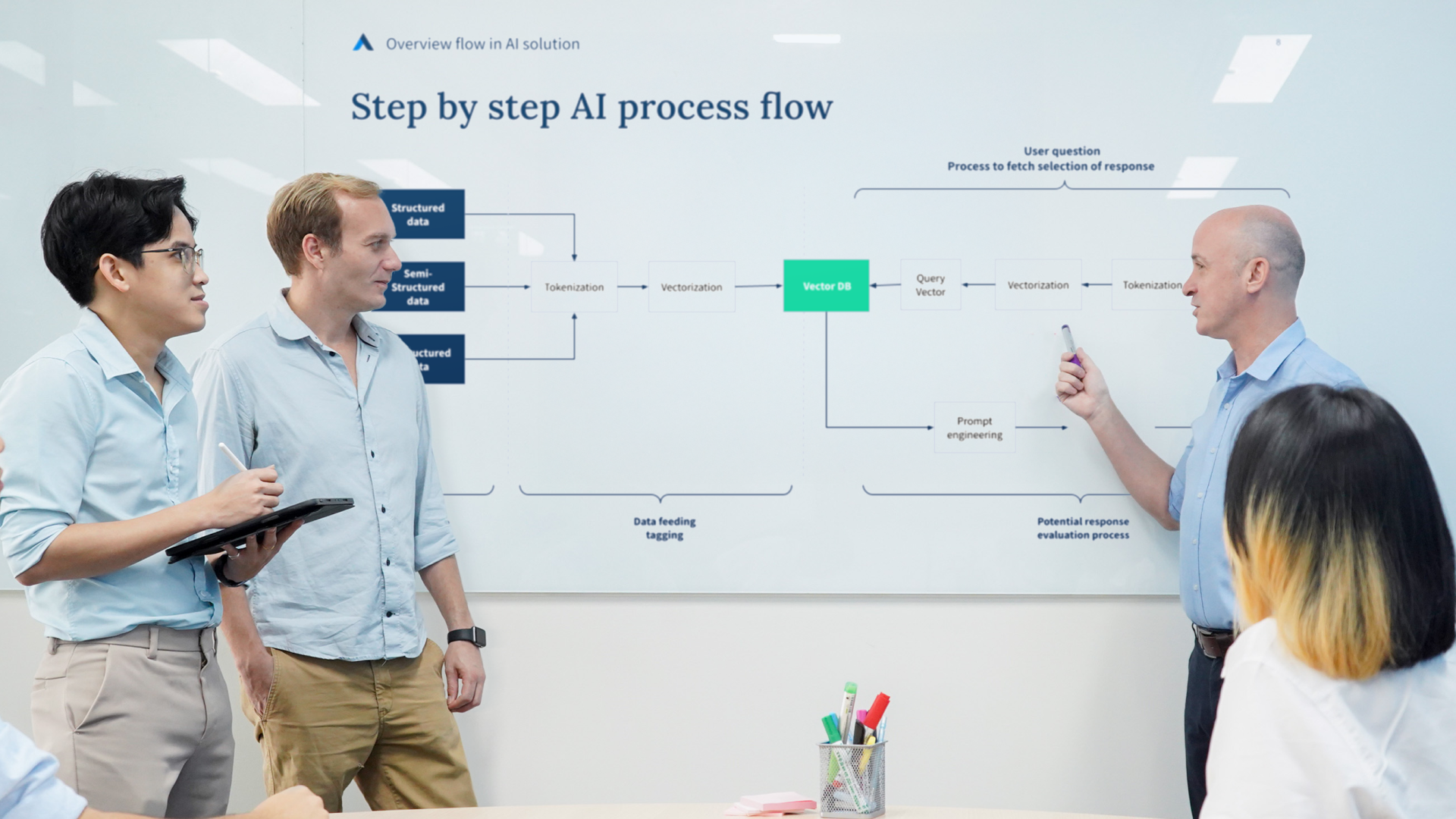
Retrieval-augmented generation (RAG) is a technique software development teams can use to connect generative AI to your business knowledge at query time. Rather than relying solely on what a model learned during training, RAG retrieves relevant information from your own data sources and uses it to generate accurate responses. The process follows three steps:
The breakthrough: A simple idea with a massive business impact.
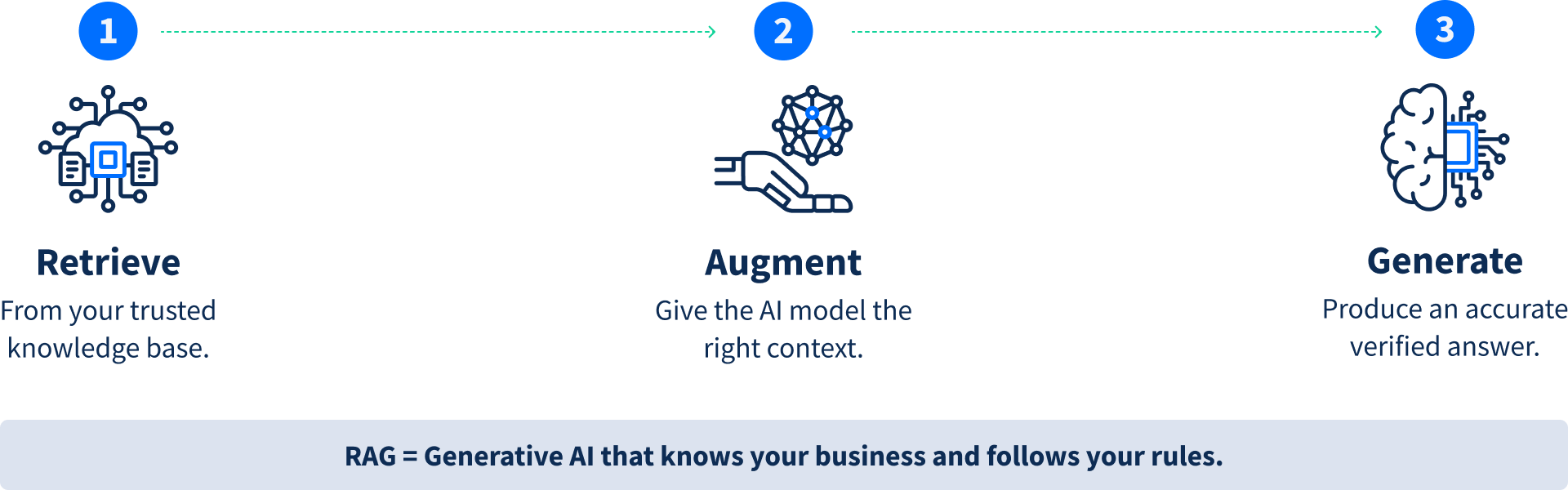
- Retrieve: Pull information from trusted knowledge bases, such as policies, procedures, manuals, and internal datasets.
- Augment: Add this retrieved context to the prompt, giving the AI the specific information it needs to answer the query.
- Generate: Produce an accurate, verified answer grounded in your company's actual data.
Benefits of RAG for enterprises
Implementing RAG transforms business operations by addressing core inefficiencies through a unified approach to intelligence.
RAG accelerates decision-making by providing employees with a correct answer instantly, eliminating the need to search through multiple systems. The approach also reduces enterprise risk because every response is grounded in approved, internal documents, which dramatically reduces the likelihood of AI hallucinations.
RAG also boosts productivity by giving employees instant access to institutional knowledge instead of digging through folders or pinging colleagues. And because the underlying model doesn't need to be trained on proprietary data, there's no risk of data leakage or costly retraining.
How leading companies are using RAG
Leading organizations are already using RAG across various departments to drive results:
- Customer service: Delivering consistent answers while reducing handling time.
- Sales enablement: Creating tailored proposals based on product catalogs and historical wins.
- Healthcare & pharma: Providing compliance-driven responses grounded in approved medical and legal literature.
- IT/operations: Resolving help desk tickets faster with instant access to documentation and past fixes.
- Manufacturing: Empowering workers with real-time troubleshooting directly from technical manuals and Standard Operating Procedures (SOPs).
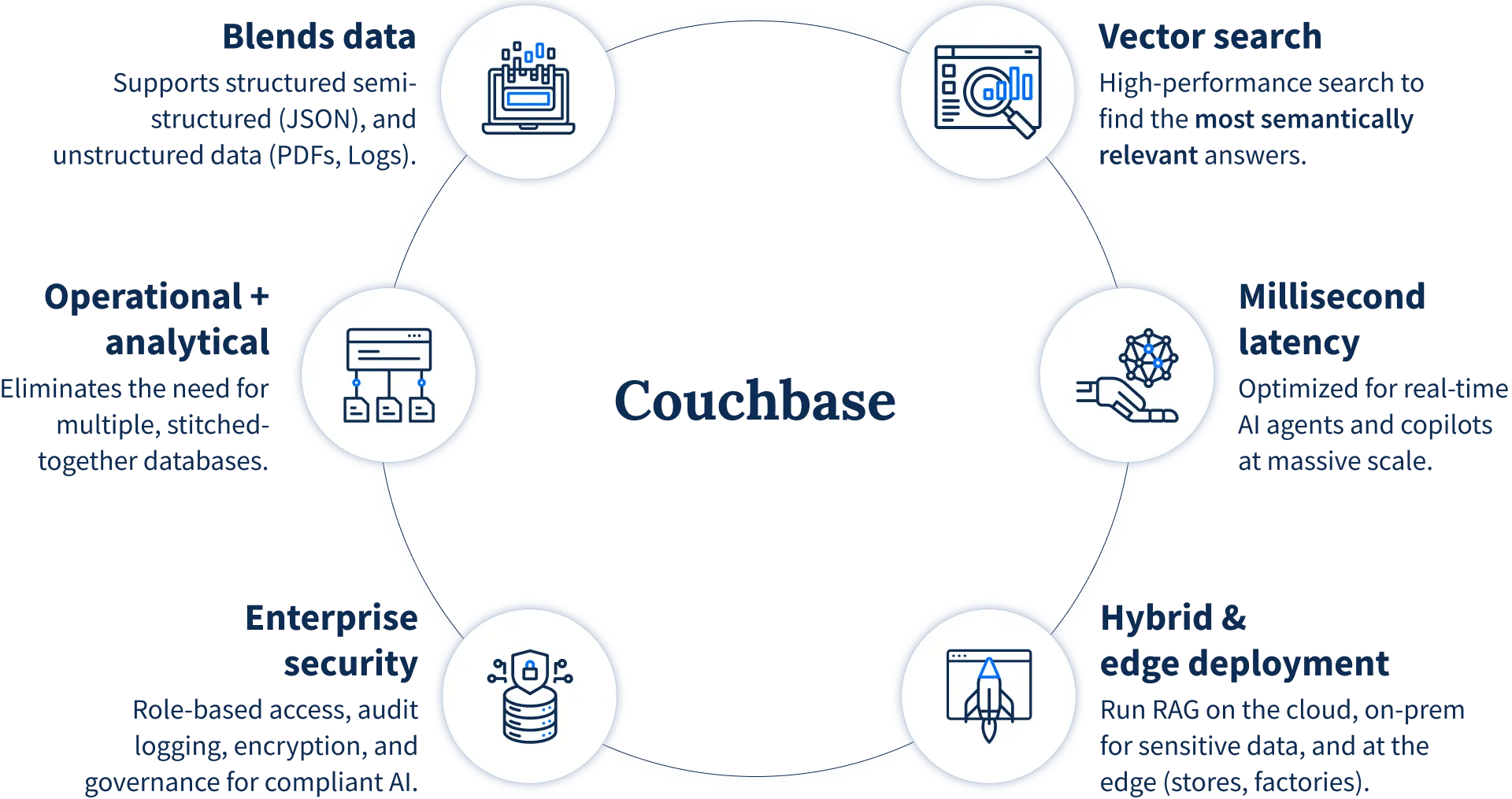
Couchbase was purpose-built for these AI demands. Unlike traditional databases that struggle by focusing on only one function, Couchbase integrates document store, transactions, and vector search into a single platform.
Couchbase was purpose-built for the demands of modern AI applications.
Case study: AI-assisted maintenance at the edge
A powerful real-world application of this technology can be found in data center maintenance.
The problem
Contractors in secure zones often cannot use external devices or the internet due to compliance requirements. Printed manuals are often bulky, outdated, or unavailable, leading to wasted time matching part numbers.
The Couchbase solution
Using a tablet-based AI system, contractors can operate fully offline in air-gapped environments. The system uses Couchbase Lite's local vector store. When a contractor captures an image of a hardware component, the image is vectorized on-device and searched against the local knowledge base. The relevant service manual or troubleshooting steps are then displayed instantly
The result
Faster repairs, more productive contractors, and full compliance with data security protocols.
Takeaways
Retrieval-augmented generation fundamentally transforms enterprise operations by allowing AI to generate responses grounded in verified, internal knowledge, effectively bridging the gap between raw data and actionable insights. This breakthrough relies on a seamless three-step flow—retrieve, augment, and generate—which ensures that AI models follow company rules and significantly reduces the risk of hallucinations. The success of this system depends on a robust database foundation featuring high-performance vector search, which enables the semantically relevant, sub-second retrieval necessary to support real-time decisions at scale.
Shivay Lamba
Senior Developer Experience Engineering - AI
Shivay is an experienced Software Engineer with a strong background in architectural design. He develops robust and scalable solutions. Skilled in full-stack development, DevOps, and cloud-native systems with hands-on work in AI/ML, real-time systems, and scalable microservices.